Tuesday, April 19, 2011

Tuesday, April 19, 2011 - Costa Baja, La Paz


When we left Puerto Escondido, we were headed north to Santa Rosalia which we had loved last year. The first day out we did not run far, only to Isla Coronado, because I wanted to stay in phone and internet range through the night. We were on the SW side of the island in a bay which has a large sandbar to the south and it is a lovely anchorage. We were not the only ones there, but there is plenty of room for all and we enjoyed a peaceful evening at anchor before heading north.


Our first stop, on the 8th was Bahia San Juanico. This is an extraordinary bay, with wonderful rock formations which rise around you like church spires. It has wonderful protection from the north as well as small area on the south side that would be great in south winds. And there we remained for two lovely days while the wind came up and blew 35 from the NW on the 10th.


There seemed little point in bashing into the waves when we were in such a nice place. We wandered the beach with Daisy looking for agates. I don’t think we found any, but we did pick up some extraordinary rocks which I will take home to James, our grandson. I am toying with the idea of buying a rock polisher. Some of the rocks are conglomerates of wonderful colors. I don’t have any idea if they will polish or not.


Our first afternoon, we invited a young couple that had rowed around the bay in for a beverage. They are Marni and Mike, from Sidney, Vancouver Island. They have a 37 foot steel sailboat named Picara on which they have done a ton of work. They plan to go back north to replenish their bank account, but next year they will continue their cruise. It is always a pleasure to see young couples enjoying the cruising life. They do all the more active things - like rowing around the bay and hiking the hills. I asked what Picara meant and Marni said she would like to know. They understood from the dictionary that it meant hobo or wanderer in Spanish but given the smirks they get from the local men they are curious as to whether it has a somewhat racier meaning, at least in Mexico. She hopes that it is not too wild. I discussed it with Maria Luisa and Marni can relax. In addition to meaning mischievous, naughty or cheeky, the most common meaning in Mexican slag is flirt - but definitely not slut.


The next day, the wind howled. That morning we had a visit from the smallest inflatable dingy I have ever seen - certainly no more than 5 feet long - rowed by a pretty petite young woman named Nina. She was hoping we could fill her 6 gallon water tank, which was not problem at all. She came in for a cup of coffee and we learned she and her husband are Norwegian and have been living on a 27 foot sailboat, Bica, on which they have sailed from Norway. 27 feet is really very small. Her husband is a serious writer and has published a number of novels. When I asked, she admitted that being written for Norwegians they were not light hearted. She is busy writing a book on Seppala who ran the serum to Nome by dogsled in 1925. She is from the very northern part of Norway. Seppela came from a nearby village and, like her, was part Finish, since many Finns over time migrated from their northern hills to the Norwegian Coast. Somewhat embarrassing for us having spent 30 years in Alaska, she knew far more than we about the early 1900s in Alaska and in Nome specifically. Earl had a great aunt and uncle who had lived there in 1905 so it is particularly interesting to us. We invited her to come over in the evening for drinks and she said she would bring us copies of some of her research materials, including a who’s who from Nome in the early 1900’s.


Nina brought over a portable drive. In addition to a special file that she had compiled for us about Nome, she had several thousand digital books, a translator which would put them in Kindle format, a bunch of books on tape including all the Harry Potters and some NPR podcasts. The last two should be wonderful for night watches.


We also invited over Marni and Mike from Picara and Lewis and Laura from the sailboat Cirque which was anchored next to us. Everyone brought goodies. Marni had bread and humus, both of which she had made from scratch that day. Most impressive, Nina brought some sweet Norwegian yeast bread that she had baked over charcoal in the barbecue - she said they were running low on propane. Lewis and Laura are racers and had lots of stories to tell of the Puerto Vallarta sailing regatta. They have won several years in a row and this year the race committee gerry rigged the handicapping to try to favor others - they still won. We made fun of the dour nature of Norwegians and Finns. Marni brought up the subject of Margaret Attwods books - she is Canadian- and I said I liked them but found them rather dark. Nina respond that for her it was comedy. Lots of fun. We are happy that we will be seeing Nina and Hendrik (who was busy with his manuscript and did not join us) this winter. They will be house and dog sitting in Wasilla, Alaska.


The next day the wind out of the north was gusting 35 and we decided against heading north into the seas. We will leave our visit to Santa Rosalia until the fall and combine it with exploration of the Bahia Los Angles area. Instead we headed south, back to Coronado with the wind and seas on our tail. This boat is made for such weather and we had a lovely ride.


Because of the north winds, we anchored on the south side of the island and watched the surf curl around the ends of the land, while we sat snug as could be at anchor. As predicted, the next morning, the 12th, the winds had died allowing us numerous alternatives. We chose to stop first at Loreto. Earl took me into the small boat harbor in the dingy and I went shopping for milk, fruit and vegetables. Then we headed over to a beautiful little cove on Isla Carmen called Balandra. In addition to being lovely, it gets good cellphone reception which was important. Everything was perfect, except for a swarm of thirsty bees which decided to populate our back deck in a search of fresh water. Since it did not look as if we would be able to barbecue, we took off and headed for another anchorage, La Lancha, on the north side of the island. We had it to ourselves and enjoyed the beauty.


The following day, we headed south. The forecast for the following days was for big winds from the north so we made our way to Agua Verde which is a wonderful anchorage for north winds. The first thing we saw was a man fishing from a tiny kayak. We had a chance to visit with him the next day. He is Milo from the Chek Republic and told us that he had come to the USA in 1988 as a cook on fishing vessels in Alaska. 9 years ago he retired, quit drinking, and found a young Chek girlfriend. He has been living in Mexico ever since. He had been in Agua Verde since October, living on the beach in a 20 year old white van with a blanket over the back, subsisting on fish and love.


We had a lovely time exploring the beaches on Agua Verde. The water was exceptionally clear and appropriately green and in the shallower areas of the bay we could clearly see lots of colorful fish. Daisy loves going on dingy rides. She hangs over the front like a hood ornament.


One of the boats in Agua Verde was a 46 foot Nordhavn, Discovery. We had met her last year just north of Conception. Frank was the one who returned Earl’s cap to him in Escondido and we were lucky to have a opportunity in Agua Verde to get to know Frank and Linda better. They worked in the Seattle area and a couple of years ago they cruised south in the boat which is now their home. They will continue the life style as long as it suits them both. They invited us over for drinks. Their boat is lovely. it has a large salon and a good galley. The master stateroom is in the bow which allows them lots of light and air on a normal basis while the smaller mid-cabin is available if the passage is rough.


The wind howled the second day we were in Agua Verde. In this dry desert land, we found that the wind off the land brought with it lots of red dust which coated the boat and got in our eyes. Hopefully this is an unusual thing. We have not encountered it before.


The next day, we headed south. Our friends John and Maria Luisa were headed for the Hook on the south side of Isla San Francisco and we had arranged to join them. The plan was to stop on the way at Los Gatos and buy some lobsters for dinner from Manuel. We stopped for about an hour at lunch time and called several times on the radio, but no Manuel, no lobsters. Happily, I had a kilo of small scallops in the freezer and I know there is nothing that Maria Luisa loves better than scallop ceviche. It is, additionally, simply to make. Cover the scallops in lime juice and a little salt. While they sit, chop up onions, tomatoes, jalepenos, and cilantro. Mix the vegetables with a little olive oil, drain and add the scallops, add salt and a little tabasco to taste. By the we arrived at the Hook at 4:30, we were ready to entertain. Maria Luisa, John and their friends, Guy (born in France of Danish and Hungarian parents) and Lolita, his Mexican wife, came and feasted on scallops and white wine. It was a lovely evening.


Early the next morning, the wind came up from the south so we pulled anchor and moved to an anchorage on the north east side of the island. The beach was very rocky, large cobbles, of wonderful colors, including reds and greens.


After a stop here, I pulled up the weather for Earl. To our surprise it was suddenly calling for significant east winds. If it was right, we were not in a good place. We pulled our anchor were headed south, when Earl pointed out the the forecast included 16 to 17 foot seas. WOW! Well, to err is human. The weather report was correct for latitude 24 and longitude 110 - in the southern hemisphere. Earl has significantly reduced my performance rating as meteorologist and is threatening to cut my salary.


Since we were already on our way, we headed to our favorite anchorage at Caleta Partita. Glad we did, for once again, the winds came up and it was good to be in a safe anchorage. It was blowing from the SW, so we thought we would go around Isla Espiritu Santo to Bonanza on the SW side. As we left the anchorage, we ran into bumpy seas and a south wind. After bouncing around a little, we found a lovely cove, Galina, and pulled in. It was good in a south wind, but would not be good in the forecasted SW, so after lunch we pulled anchor to head around the island. We did not get far before Earl decided that the wind was definitely more S or SE and that the Bonanza anchorage would not work. So instead we headed to Balandra, a lovely anchorage not far from La Paz. The wind had disappeared, the water was 74 and beautiful and we floated around and enjoyed ourselves. As we watched a lovely sunset, all of a sudden we had a south wind gusting to 35. It was a rocky night, and Earl was up multiple times checking our anchor and keeping and eye on the other boats around us.


Today, after having spent almost 2 weeks running from the weather, we headed back to our slip in Costa Baja. Our supplies are low, the boat is dirty, the temperature is in the 90;s and we are happy to be ‘home’.

Thursday, April 7, 2011

Thursday, April 7, 2011 leaving Puerto Escondido heading north

AprilAfter we arrived in Costa Baja on February 20th, we spent a few days in La Paz getting ready to leave and then on the 24th we flew to Mexico City. Our wonderful friends, John and Maria Luisa, met us there and took us to their lovely new home in Cuernavaca. I had last visited the town in the late 60’s when the population was about 100,000. It is now about 1,000,000 and what a change. In the 60’s my aunt had a lovely house downtown by the zocolo and I remember that we would stroll there in the early evening. Back then there were a couple of sidewalk vendors selling straw baskets and it was a lovely place to sit and enjoy a peaceful drink. I had the address and we went looking for the house. It was almost impossible to believe that what had once been a lovely charming little town square was now a traffic congested place. How sad!


Although the downtown has lost much of its charm for me, John’s house was absolutely lovely, very modern, very airy with a lovely pool and patio. We had a wonderful visit. John has a couple of restaurants “Vicingos” (Vikings since John is Danish) which he started and his sons now run. So when we did not go out, he would just call and order food. Very convenient!


We took a day trip to Taxco, which is where most of the Mexican silver is mined. It is a very old town and is built up the side of a mountain. It looks Mediterranean rather than Mexican because all the houses are painted white. There is a beautiful old cathedral dating from the 1500’s. John has a branch of his restaurants there and we sat on the patio and enjoyed the view with our lunch before traipsing through town.

View of Taxco Cathedral at Lunch


Our visit to Cuernavaca was too short, Thursday evening through Sunday morning, and then we were back in La Paz to catch our flight to Anchorage. We over nighted in LA and arrived midday, March 1st, to Anchorage which was snow covered and dazzling under a lovely blue sky. The snow on the back deck was 3 feet high and Daisy found it a little overwhelming.


We were blessed with three weeks of glorious weather, and by the time we left the creeping phlox was gradually showing up where the snow was gone behind our house. It was wonderful seeing the grandchildren. The price was sharing the illnesses making the rounds of the Anchorage preschools. The down side was that we got sick. The upside was that for several days Amelia did not go to preschool and we had her for the whole day. She is two and chattering full time so we are really getting to know her.


Amelia multi-tasking- watching Dora the Explorer on the I-pad while planning her trip to Finland


Bella and I got to spend several days together as well. Our visit home coincided with Fur Rendezvous, the midwinter Anchorage festival. Among other activities, Bella got to take a dog sled ride. Then we enjoyed two trips to see an exhibit of Mammoths and Mastodons from the Field Museum in Chicago which was on tour. The second trip included Steve’s three teenagers including Elora, aged 13 + who patiently put up with being Bella’s prisoner. We saw many friends and the time flew bye. Finally, with our income taxes sort of taken care of and bills paid, we left on the 24th for warmer weather to recuperate from our colds.


Bella taking a dog sled ride


We had a long trip back, leaving Anchorage at 1 am and arriving at 4 pm making a long day for us and even more for Daisy. We were able to break her out for breakfast and a walk in Seattle, but otherwise it was a long day in her crate.


We spent the next five days getting over my cold and preparing for Roland and Nancy who were due to arrive on March 30 to spend a week with us. Apparently I was not too ill since we managed an active social schedule. We saw a good deal of Herve, who has spent 25 years in California but is originally from Brittany. His wife, Helene, had returned to California so he was by himself and easily persuaded into drinks or dinner.


We had brought two new laptops with us, one PC and one Mac, to replace the two Dells we had on board which were beginning to act up. One, the PC, will be dedicated to navigation, while the Mac will be used for other stuff, such as blogging. We had also brought a wireless modem with the thought that we could create a WI FI hotspot on our boat and use the email and internet capabilities of our I phones as well as being able to move the computer around the boat without losing the internet connection. I was supposed to transfer everything on to the new computers and get the new equipment set up. I got stuff loaded on the Mac but we are still using the old Dell for navigation. The real problem turned out to be with little cradle-point wi fi modem that Earl had found. The directions were very sparse and I was unable to make it work properly. The more I tried, the worse it got. By the time I was through, I could not even get the internet cable connection to work. I hate being the “Help” desk and my frustration did not make the atmosphere in the boat a harmonic one. Fortunately another cruiser came to my rescue. Peter, from the Solara, a Nordhavn 64, has an impressive technical background and spent two hours working on my problem. He finally found the one little setting that needed to be changed and soon I was able to create a wireless hot spot on the boat using either the cable modem or the little Telcel stick modem. We celebrated that evening at Peter’s with a bottle of champaign after picking up Roland and Nancy at the airport.


After drinks at Peter’s including a tour of his beautiful boat, we took Roland and Nancy to the Beach Club Palapa for a dinner overlooking the beach. They loved it, as we knew they would. The next morning, bright and early as is Earl’s way, we took off to spend the day exploring the Espiritu Santo marine preserve. We hit two beaches, San Gabriel which has a beautiful long sand beach and a frigate bird rookery, then Cardoncita on Isla Partita, which we had not visited before. It has a nice area for snorkeling and Nancy and Roland had their equipment on almost before we had the anchor down. Finally, around four, we moved on to our favorite anchorage at Caleta Partita. Having seen no boats the rest of the day, Nancy was shocked that we had to share the anchorage with 6 or 7 other boats. It was lovely.

Roland, Nancy and Daisy approaching Espiritu Santo


Frigate Bird Rookery in Bahia San Gabriel


The next morning we headed north to Isla San Francisco. Our plan was to catch some fish and then anchor at the Hook on the south side of the Island. It was not to be. No fish, and then a wind from the south required looking for a different anchorage. We spent mid day anchored on the East side of the island. Then the wind went down and we tried cruising around to catch a fish - still not a bite. However, we did have a thrill watching a school of small rays, mobulas, near the boat jumping and flying through the air. We ended up anchoring behind a spit on the SW side of Isla San Jose called Amortajada.


Nancy captured by the Girl who Played with Fire


The next day started with a dingy ride through a small mangrove lagoon which was impressive a high tide. We then explored a beach further north on the island at a site which was once a salt mine. There are a few piece of abandoned equipment and the salt ponds still have some salt. We could have just filled up our containers with sea salt had we wished. I had heard that one could occasionally find a nautilus shell in the seaweed here. We found none but enjoyed our walk and Daisy really got to explore and stretch her legs. Then we headed 4 miles across the San Jose Canal to the little town of San Evaristo, which boasts about 20 families, a school, a desalinization plant, a cantina and tienda (little shop), goats and mules. The fishermen were unloading their pangas and had some pretty impressive catches of yellow tail. The pangas are open boats, but the pangeros have developed a low cost model of fish hold to keep their catch fresh. It is a 50 gallon plastic barrel which has been sprayed with a heavy layer of insulation, laid on its side with a lid cut into it. Very functional - the catch looked beautiful.

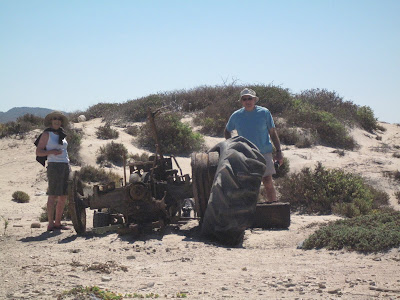
Roland and Nancy check out some mining equipment


We wandered through the little town and gave Roland and Nancy a taste of rural Mexico. The tienda was quite well stocked and we were able to pick up onions and tomatoes. Nancy picked up some packages of cookies and later discovered what we already knew: Mexican cookies have zero taste.


We had cocktail hour on the top deck watching several sailboats coming in to anchor. One was no more than 20 feet long, and another was from Juneau Alaska and painted blue with the stars of the Alaska flag on its side. One of the interesting things was watching the fisherman catching bait for the next day. They use throw nets from the bow of their boat and it is a lovely thing to watch, it looks very easy and no doubt is a very difficult thing to do.

San Evaristo


A wild 35 mph wind came up that night and we rocked a good deal, but we were well and safely anchored. One of the sailboats was not so well secured and came floating by us. We woke to the sound of roosters crowing and mules braying. It was another beautiful day and we were off to catch fish.


We cruised north up the Canal San Jose and then around the island of San Jose and down along the east side before heading back to the west and our anchorage at Los Gatos. It was a 10 hour day of fishing with no fish. In fact, this trip we saw relatively little in the way of sea life. Finally, just before we anchored we saw a couple of large whales. They were not so near or so spectacular to normally have been of much interest, but we noticed another boat tracking them. Obviously they had seen little sea life as well.


We had called on the radio saying that we were the Serenity and going to Gatos and hoping to buy lobsters. When we arrived was no one else there. We anchored and went up above to have a drink and admire the beautiful red rocks. Five minutes later, Earl saw a panga coming from the south - Manuel and his lobsters were coming. We had last see Manuel just before Christmas. He had been ill and we were worried about him. He greeted us with big hugs and told us that he was feeling much better. He had been one month in La Paz and had a small operation that solved his problem. He was happy to see us and after selling us 5 kilos of lobsters for a modest sum, he sat and had a beer. He can no longer dive for lobsters, so now he catches them in a net. The problem is the market. The Canadians and Americans frequently all show up at once and he runs out of lobster, which seems to be the only thing they want. He was saving to buy a second net, which would cost close to $100. As one fisherman to another, Earl contributed to the cost, and we all got more hugs. We feasted on lobsters, leaving 3 for lunch the next day in Earl’s live tank. Earl and I retired, leaving Roland and Nancy to skinny dip.

Manuel enjoying a beer


The next day, Earl was up early taking photos of the beautiful red rocks in the sunrise. There was Manuel in his panga with a gift of beautiful little bay scallops. He came by again as we were leaving to show us his catch and the net he is planning on duplicating. I think as long as Manuel is well, we will have lobsters waiting us in Los Gatos.


It was a short run up to Agua Verde - no surprise, no fish. We arrived in time for lunch on the boat deck: cold soup and lobster salad. Roland and Nancy explored the town and visited Marie’s tienda. Earl and I had our heads into our books. Later in the afternoon we saw the local goat herd making its way across the hill in front of us.

Agua Verde Sunset


Tuesday, our last day of cruising, we ran up towards Puerto Escondido. We ran around the east side of the Isla Danzante where we finally found a pod of bottle-nose dolphins that played with us for a while. I am glad that we finally found some before Roland and Nancy left. Then our final stop before Escondido - Honeymoon cove for lunch and a swim. It was beautiful even if we had to share the cove with another boat.

Honeymoon Cove


We anchored in Puerto Escondido and arranged for a rental car for the next day. Then friends began to arrive. First, Steve and Tawny from the sailboat Imagine whom we had last seen a year ago in Bahia Conception where we spent several days weathered in. We had just started catching up with them when a dingy pulled up from the Nordhavn 46, Discovery, bringing Earl back his Nordhavn hat which he a lost in Conception to Gary who reports the sunrisa net weather. Not long after, our friends from Port Don Juan in the Bahia de Los Angeles, Gordon and Miriam from the 31 foot Golden Hind, Anwagomi, showed up. We all had a good time and it was fun introducing Roland and Nancy to some of our cruising friends.

Puerto Escondido


That night we had dinner on shore at the Portobello restaurant in the marina. The restaurant overlooks the anchorage and it is impossible to ignore how beautiful it is. Then, too soon, it was Wednesday the 6th and time to take a quick tour of Loreto before dropping Roland and Nancy at the airport for their flight home. We toured the old Cathedral in Loreto. The mission was established in 1697 and was responsible for sending out the missionaries that established the missions in California. Then Nancy demonstrated some of her power shopping skills before we had a quick mexican lunch. We came back to a boat that seemed very quiet.

Lunch in Loreto


Gordon and Miriam came over and we had a nice visit with just the two of them. Gordon is a radio ham and gave Earl some tips on getting our single sideband receiver working. We were able to hear something this morning, even though we could not understand what was being said. We will give it another try tomorrow when the weather report is scheduled.


We are now headed north and for the first time in a week we have telephone and internet available. I paid some bills, checked the emails, and will post this while we are still able to do so. Our next chance will probably next week when we are planning to be in Santa Rosalia.

Tuesday, February 22, 2011

Monday, February 21, 2011 - Costa Baja Marina La Paz


Thursday, February 17, 2011 – Underway from Barra to San Blas

Yesterday around 11 am we said good bye to Stu and Teri, left them behind at the Grand Bay Hotel in Barra to kill a few hours before going to the airport, and we headed north. We are trying to make a fast trip back to La Paz so as to fit in a quick visit to our friends John and Maria Luisa in Cuenavaca before heading back to Anchorage on the 28th of February. The weather forecast was ideal, and, delightfully, has proved to be accurate. We had about a knot plus of current going our way, and, as we made our way toward Cabo Corrientes and Banderas Bay, we were running at over 7.7 knots. The sea was glassy and there were lots of turtles and whales to entertain us. The turtles were about 3 to 4 feet across but I don’t know what type. We had planned an overnight run around Cabo Corrientes and into La Cruz in Banderas Bay, but sometime yesterday we decided to skip La Cruz and save some mileage by running to San Blas. It is now 9 am, the seas are glassy and we have about 20 miles to go. We will have come almost 200 miles in 25 hours.

Earl suggested that I include some lessons learned about cruising this part of Mexico. First, bring some bug spray and use it. We finished our favorite and I did not put any on when we were in Barra. I am covered with bites – from my toes to my forehead. Second, unless you want to drink only bottled water, you need a high tech water filter to fill your tanks or a water maker. We have been spoiled with the reverse osmosis water in La Paz. Third, the anchorages on this side have far more swell than in the Sea of Cortez, so a flopper stopper of some type improves sleeping conditions. Fourth, communications are always an issue. We have AT&T phones with the Viva Mexico plan and have pretty reasonable telephone communications. Don’t plan on using an IPhone for data. Earl did and even with a Mexican plan we had a $300 bill last month. Wi FI connections at marinas are sometimes weak and I am going to look into getting a signal amplifier for my computer. The telcel stick works okay if there is a signal but is never very fast.

This winter is apparently unusually cold. We noticed it is about 10 degrees colder than last year, both air and water. Perhaps this accounts for the lack of fish, which others have noticed as well.

Friday, February 18, 2011 –Isabela and Mazatlan

I took a nap and returned to find that that we were now headed to Isla Isabela instead of San Blas. Isabela is 20 miles further north and we arrived there at 2:30 in the afternoon. Once again we saw tons of turtles today. They really show up when the water is so glassy. We anchored south of Las Monas right behind a panga. The pangeros were anchored and cleaning fish. Later they all took naps, apparently giving their nets time to set. It reminded me of gill netting in Cook Inlet when beautiful glassy seas inevitably meant slow fishing and dozing in the sun. Off our stern small rays jumping, five or six at a time, entertained us. It was a lovely stop.

The plan was to start off again early the next morning. I foolishly thought that meant five or six am. Oh no, 1 am Earl pulled the anchor. I slept till he told me it was my turn at 3:30. Again, it was another beautiful day. I pulled up the weather and it promised good weather until Saturday night. We decided to make the best of it and just keep going to Baja. First we had to stop in Mazatlan to get some fuel. We had a couple of hundred gallons which was plenty, but Earl wanted more weight in the boat in case we got into rough weather.

We got to Mazatlan around 3 pm, after a 95 miles run. We were greeted by boobies and frigate birds that circled the boat and tried to land on us. The radar seemed to keep them off. Once into the estuary, we headed for the Pemex station. It was off the main boat basin and we discovered that we had picked one of the lowest tides ever to come in. We had stirred up mud by the time we were tied up and after taking on 400 gallons, we had no water under the keel. Fortunately the tide was coming in and the bottom was soft, and with the help of the fuel dock personnel we got turned around and headed out for La Paz.

Actually, we are planning on heading for an anchorage on the SW side of Isla Espiritu Santo called Bonaza. We should arrive around midnight on Saturday, + or – several hours depending on the current. There we can rest and make an easy run into the marina on Sunday morning. Docking there will be a challenge since the thrusters are partially clogged with marine growth and will be of no help. As we left Mazatlan, we had gone about 300 miles and have about 250 left to La Paz.

Saturday, February 19, 2011 – Crossing the Sea of Cortez

Last night was beautiful. We have a full moon and perfect weather. Aside from a couple of ferries, we saw no other boats. We are finding that between 4 and 5 hours is as long as either of us can stay awake on watch at night. If we did more of this we might even get into the routine of breaking our night’s sleep into segments.

We have been fortunate to have a current with us. Without a current at 1800 rpm we cruise at about 6.5 knots. With the current against us, it can be as slow as 5 which is a significant difference. Fortunately so far we have been going faster, sometimes as fast as 7.9.

Around noon, we were cruising along at 7.5 knots on glassy seas about 85 miles off shore when we started to see marlin. Earl quickly put out his fishing gear. I guess it is only the journey when there is no fish – if there are fish, it is the fish not the journey. Within 30 minutes he had one on and I was immediately transformed into the helmsman and photographer. The fish took at least 300 yards of line and started jumping as we chased him. Of course I was too busy driving to get any photos, but it was spectacular. Earl, of course, was yelling directions: go right, no left, no straight, in gear, out of gear, move everything off the back deck immediately. Daisy understood just how excited Earl was, and started yelping in sympathetic excitement. At one point, her noise was really getting to Earl and he kept insisting that I kick her to shut her up, which I refused to do. Then when we thought we were finally gaining on the fish, we saw it jumping way off. That was discouraging until we saw our fish jumping much closer and realized that it was an unhooked fish in the distance. Finally after playing it at least half an hour, Earl had it up to the back and then scared the daylights out of me as he went out on the swim step to release the fish. Half an hour later, he was still talking about it. app

Sunday, February 20, 2011 – Marina Costa Baja

We arrived at Bahia Bonaza at 1 am and anchored for what was left of the night. With the full moon lighting up the sandy beach, it was a beautiful sight and we felt that we had finally arrived home -we were only 3 hours away from La Paz. By 8 am Earl had the anchor up and we were off for the last leg of our trip. At 11 am, one hour short of 4 days (we changed time zones on the way north) we were tied up in the marina. During that time we had stopped for 10 hours at Isabela, 1 hour at Mazatlan and 7 hours at Bonaza. We had come 541 miles in 77 hours of running, averaging over 7 knot per hour, with beautiful seas and the full moon at night. A wonderful trip!

Tuesday, February 15, 2011

Sunday, February 13, 2011 - Leaving Ensenada Carrizal underway to Barra


Sunday, February 13, 2011 - Leaving Ensenada Carrizal underway to Barra

My recent silence is almost entirely the fault of Stieg Larsson and a girl with a dragon tattoo who played with fire and kicked a hornet’s nest.

It has been almost three weeks since I left for Boston for a visit with my sisters there, in Stockbridge and in New York. It was a busy week, and very snowy and brisk, especially after being in Mexico. My sister and I have been doing some renovations to the cottage in Stockbridge. What started as minor cosmetic work on the second floor – removing a dropped ceiling – has resulted in something rather more. The dropped ceiling removal revealed a damaged and mouse infested ceiling above, which when removed exposed inadequate support for any ceiling. We don’t know why it had not fallen down on its own. Anyway, there is now no ceiling on the second floor and we are free to gaze on the underside of the old roof. While the old structure has a certain beauty, the project does remind me of the Tom Hanks movie, The Money Pit.

While I was north, Earl and Daisy held down the fort, or rather the boat. They were anchored in Barra for a number of days, but that got old, even with daily visits from our French baker, and they eventually headed out to Tenecatita where Earl made friends with a number of sailors who liked margaritas.

Getting home proved rather more difficult than the trip north. There was one of many storms that the East has experienced this winter due to arrive the day I planned on leaving. I was scheduled to leave from La Guardia at 6 am and made the silly assumption that since the weather in the city the day before was unexceptional that the plane would be in NYC and ready to depart. My sister, bless her, woke me at eleven with the news that the flight had been cancelled. After an hour on the phone with Continental I made reservations to leave from Newark at 6:30 am on what turned out to be one of the very few flights to leave the city that day. At 3 am, a brave cab driver drove me through ice covered streets to the airport where I finally boarded the plane a couple of hours late. I immediately went to sleep, only to wake two hours later still at the gate. After the most through de-icing I have ever had – it lasted almost an hour – we finally took off for Phoenix, a run through that airport and on to a flight for Puerto Vallarta, which is about 130 miles from Barra. I opted for a cab ride home to Earl rather than trying to find a hotel in Puerto Vallarta. It cost $200 and took four hours including a stop in the dark on the side of the road for the driver to fix a flat, but by 10 pm I was at the water taxi station at Barra with only one last leg, a panga trip to the boat, to go before getting home. I did not realize how tired I must have appeared until Earl told me the next morning how much better I looked.

Our son Stuart and his wife Teri were due the next day, so I took the bus to the little grocery store (oddly named Hawaii) in Melaque that seems to have most everything and, most importantly, delivers to the boat, and stocked up on fruit, vegetables and milk.

Our time with Stu and Teri has flown by. We were anxious to explore some of this area with them. The first morning we took off from Barra and headed north to Tenecatita which is a beautiful stop. The seas were a little bumpy and the short two hour trip was long enough to make poor Teri sick. She was very stoic and as soon as we got into the bay and the water flattened out, she was ready to play. Down came the kayaks, and Stu took Teri off for her first kayak trip.

We managed to talk Earl into spending two nights in Tenecatita. Since it is literally all about the journey with Earl, that was quite a feat. We all enjoyed this quiet time together. But you can’t keep a good man down, so on Monday the 7th we were off again, heading north. On the way out of Tenecatita, we finally got a fish. Stuart hooked a large jack cravelle which gave him a pretty good fight. They are not particularly good eating so after getting a photo, we let it go.

I had hoped we could stop at the picturesque town of Cayares with its brightly painted houses, but Earl remembered too well the night we anchored there and he had been force to sit up all night. Instead we made our way to the islands in Chemela Bay where we had scoped out possible anchorages on our way south with Joan and Clark. The first one was full of people and pangas. Being the closest Monday to February 5th, one of many revolutions that the Mexicans celebrate, it was a national holiday and the locals were enjoying it. We anchored off the smaller island which had a good size colony of boobies and frigate birds. Stuart explored by kayak and took photos.

The next day we moved a few miles into the bay and anchored in front of the little town of Perula. Teri and Stuart were enjoying the fresh orange juice and local fruits and our supply was running low. Earl dropped us off in the water off the beach. There is a bit of a swell in front of the town, and he was taking no changes with his dingy, so the drop off was literally in the water. Off went the three explorers hoping to find some vegetables and fruits. We walked through several yards looking for the main road. In one we walked by a darling little half naked boy, aged about 2, who gave us a big hello while the family dog lay nearby not moving a muscle. Once on the main road we started stopping by any open door that looked remotely like a tienda. We met a Canadian couple who were renting an apartment in town and asked about buying fresh fruit and vegetables. The news was discouraging. We were told that the best bet were the trucks that would come through town from time to time. They always had loud speakers and would announce what they had for sale, but there was no schedule and no way of knowing if any were coming into town. According to them the little shops were not likely to have much. After that warning, we were delighted by how much we found in the first shop we encountered. We loaded up on oranges, pears, onions, bananas, tomatos, mangos and peppers. A little further on, we bought a pineapple, and then some tortillas and strawberries, and finally some shrimp. This is not a place where one goes to shop for anything specific, but it is great if you are an opportunistic shopper.

We stopped at a place with four tables out front for lunch. The menu consisted of some paper signs on the wall each advertizing one dish. Stuart had enchiladas and Teri and I had cheese quesadillas. They were wonderful. The best part was a bright green salsa that had a wonderful fresh taste. I told the proprietress that it was best salsa I had ever had and asked for the recipe, which was simplicity itself. Take five or six fresh jalepenos, cut off the stem, and put them in the blender with a clove of garlic and some olive oil and salt. We later tried it on the boat with great success.

While we were there a young man – rather nice looking and studly but with far too many tattoos for our taste – sat down at the table next to us. He spoke no Spanish so I helped him order some orange soda and we started talking. He turned out to be Norwegian and one of the stars of a Norwegian reality show being filmed nearby. Teri and I quickly took the opportunity to have our photos taken with Nicholas.

The next day we started off at dawn, with Earl determined to catch some fish. We ran about 20 miles off shore and encountered our first group of spinner dolphins which were quite spectacular. Stuart managed to get a video of them near the boat and one can hear Daisy’s excitement in the background. The seas were lovely. Earl ran the generator and the water maker all day. Teri and I did a huge load of wash and hung most of it out to dry on top of the house. Then we had quesadillas with our new salsa for lunch while watching another group of dolphins. They were followed by some whales who put on quite a show for us. It was a lovely day, with one exception - no fish. After 7 or 8 hours, we headed towards our anchorage. The wind was coming up and it seemed like it was time. Just then, Teri called out “fish on”. Stuart and I ran back while Earl ran the boat. The fish was taking out line, but we could see it on the surface. As Stuart pulled it in, we were more and more puzzled. At first we thought it might be a skate, then a shark, then a piece of plastic. Teri was the first to identify it as a purple lululemon XL on a hanger. Stuart had caught his own tee shirt which had blown off the top of the boat. We never had more fun with any fish!

We anchored in Carrizal. It is a small anchorage and reminded us of Alaska. There are steep sides and no sign of civilization other than a couple of sailboats. After the long day before, Earl was content to stay put and we had time to enjoy the anchorage. Stuart went snorkeling and reported there were more fish than he had seen before. We explored the cove by dingy and kayak and found two blowholes which made a goodly noise. It was a peaceful night, no rocking. Earl got up in the middle of the night and was excited to hear whales nearby, until he realized it was the blowholes.

The next day we ran a few miles down to Las Hadas at Manzanillo. Las Hadas is very picturesque, with steep hillsides are covered with white buildings and multicolored flowers. It is lovely. Stuart, Teri and I went off to explore the town of Manzanillo. We opted for a cab for the ride to town and were lucky to have a wonderful driver who went out of the way to show us the sights. The port is one of the busiest in Mexico and huge. The town is about 120,000 and very pleasant. I had the chance to show Teri and Stuart the large public market, and we were all delighted with the beautiful displays and fruit and vegetables. The meat stalls, however, took care of any desire to eat.

That evening we went out to eat at the Paradise which overlooks the anchorage. It was lovely. An open air setting that included a lovely 6 month old cat, Negro, who came by looking for food and love. Even though it caters to Canadian and American tourists, it was very reasonable.

The next day was spent at Sandiago, around the corner to the north of Las Hadas. The beach is covered with multi colored beach umbrellas and is obviously very popular. It was Saturday and the locals were out in force. Stu and Teri took kayaks into the beach and landed in the surf. They strolled through the restaurants and small shops and were impressed that they seemed to cater to the locals. How refreshing when compared to the Cabos of the world. We were visited by the couple from the sailboat Sirroco whom we had met somewhere last year. It was nice to catch up with them.

Last night was our final night at anchor with the kids. We returned to Carrazal which did not disappoint. Now we are on our way back to Barra for our last couple of days with Stu and Teri – still no fish.